"On the border issue, China always maintains that we should follow through on treaties and agreements we signed and we jointly uphold peace and tranquility at the border region," Foreign Ministry spokesman Wang Wenbin said while responding to Jaishankar's remarks.

'The Chinese are retaining geostrategic pressure on India by keeping troops there and building infrastructure continually.'
'We should not minimise the seriousness of Chinese encroachments because their perception is different.' 'Nor should we fall into the trap of accepting so-called 'buffer zones' in areas of overlapping claims. We cannot have buffer zones in our own territory,' asserts Ambassador Shyam Saran, a former foreign secretary.

Against the backdrop of recent incursions by Chinese troops into India, the two countries are working to conclude a new border defence agreement with an aim of signing it when Prime Minister Manmohan Singh travels to Beijing possibly in October.

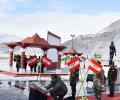
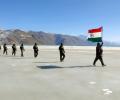
It was a scene of bonhomie as the border personnel of India and China met to mark the Republic Day in Chushul belt along the Line of Actual Control in Ladakh, putting behind the tension over recent incursions by the People's Liberation Army in the area.
Asserting that sovereignty and territorial integrity of China are "sacred and inviolable", the country's national legislature has adopted a new law on the protection and exploitation of the land border areas, which could have bearing on Beijing's border dispute with India.
The Chinese authorities have been rapidly building defence infrastructure along the Line of Actual Control, indicating that they are preparing for a long period of tension with India, points out Jayadeva Ranade, the former senior RA&W officer and China expert.
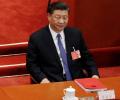
Observers say China should re-address its policies towards India or else it will continue to face flare-ups increasing the tensions between the two countries at a time China's increasing tension with the US over Taiwan and the South China Sea besides the downturn in the Chinese economy which is hit hard by the zero-covid policy.


The Indian and Chinese troops have been locked in a tense border standoff in eastern Ladakh since May 5, 2020, when a violent clash between the two sides erupted in the Pangong lake area.
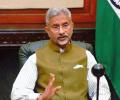
External Affairs Minister S Jaishankar will arrive in New York on Sunday to participate in the high-level 77th session of the UN General Assembly, which kicks off on September 20 with the opening of the general debate.
India has told China not to "shift goalposts" and "confuse" managing the border affairs and restoring peace at the frontiers with the larger issue of the resolution of the boundary question, which is dealt with by different designated mechanisms.

The former Congress president has been questioning the government over the martyrdom of Indian soldiers and has demanded answers from the prime minister.

Outgoing Indian envoy to China Vikram Misri on Monday had a virtual farewell call on Chinese Foreign Minister Wang Yi during which he said that "certain challenges" had overpowered the vast opportunities in the bilateral ties last year and hoped that with continued communication the two sides would be able to resolve the current difficulties.
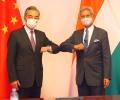
Jaishankar said full restoration and maintenance of peace and tranquillity in border areas was essential for the development of the bilateral ties.

Days after a Pentagon report said Beijing built a large village in a disputed territory in the Arunachal Pradesh sector, India on Thursday said it has neither accepted any illegal occupation of its territory by China nor has it accepted unjustified Chinese claims.
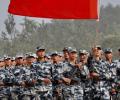
The Chinese action followed 'India's recent, illegal construction of defence facilities across the border into Chinese territory in the Galwan Valley region', a write-up in the state-run Global Times tabloid said, quoting unnamed military sources.

In a meeting on the sidelines of the summit of the Shanghai Cooperation Organisation (SCO) in Dushanbe on Thursday, the two foreign ministers exchanged views on the current situation in the region and agreed that military and diplomatic officials of both sides should meet again and discuss resolving the remaining issues at the earliest.

'Tibet remains a prickly issue between the giant Asian nations. China still claims more than 80,000 sq kilometres of Indian territory in the Northeast. Why? Just because Beijing refuses to acknowledge the McMahon line which separates India and Tibet, and this, simply because the 1914 Agreement delineating the border was signed by the then government of independent Tibet with India's then foreign secretary (Sir Henry McMahon),' says Claude Arpi.
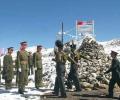
The comments came in the backdrop of the continuing standoff between the militaries of India and China at the LAC.
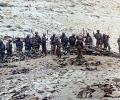
India on Thursday blamed China's actions of amassing a large number of troops close to the border and attempts to unilaterally alter the status quo along the Line of Actual Control (LAC) last year for the continuing military standoff in eastern Ladakh, and asserted that these acts were in violation of Sino-India bilateral agreements.
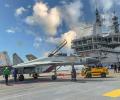
New Delhi's regional partners in restraining a belligerent China -- primarily the US, Japan, Australia and Singapore -- would like the Indian Navy to lock down the Indian Ocean Region, while the other partners can focus on deterring the PLA (navy) in the South China Sea, explains Ajai Shukla.
In the 15-year dataset, the researchers noted an average of 7.8 incursions per year even though the Indian government's estimates are much higher.

Northern Army commander Lieutenant General Upendra Dwivedi on Friday said the situation along the Line of Actual Control in eastern Ladakh was stable but in a state of "heightened alert" and asserted that there would be no security lapse on fronts of "operational preparedness and readiness" along the India-China border.

On May 5, around 250 Indian and Chinese army personnel clashed with iron rods, sticks, and even resorted to stone-pelting in Pangong Tso lake area in Eastern Ladakh.

"China's position on the Zangnan region (South Tibet) is consistent and clear. We never recognised the so-called Arunachal Pradesh," Chinese Foreign Ministry spokesperson Hua Chunying told a media briefing while responding to a question.
....a long-term boundary agreement is reached between the two countries.

The remarks of White House Press Secretary Jen Psaki came ahead of the 14th round of military-level talks between India and China on the 20-month row in eastern Ladakh.

External Affairs Ministry Spokesperson Anurag Srivastava said China's claim over Galwan Valley was not in accordance with its own position in the past, noting that attempts of transgression by Chinese side were invariably met with appropriate response from the Indian troops.
'They have done in Eastern Ladakh what we did in Dokalam in 2017.'

'China made it evident that neither the swing-ride at Ahmedabad nor the red carpet at New Delhi worked, by timing its muscle-flexing in Ladakh to coincide with Xi's visit.'
The Indian delegation led by Lt General Harinder Singh, the general officer commanding of Leh-based 14 Corps, and Commander of the Tibet Military District Maj Gen Liu Lin held an extensive meeting in Maldo on the Chinese side of the Line of Actual Control in eastern Ladakh on Saturday that began at around 11.30 am and went on till evening.
A village built by China along the Line of Actual Control in the Arunachal Pradesh sector and mentioned in a recent Pentagon report, is in territory controlled by that country, sources in the security establishment in New Delhi said on Tuesday.
...with extravagant claims in both the eastern and western sectors, observes Ambassador Talmiz Ahmad, as India is fixated on asserting its border claims based on the McMahon Line.
'I strongly urge China to respect norms and use diplomacy and existing mechanisms to resolve its border questions with India'

India and China are trying to develop effective mechanisms to prevent the "embarrassing" face-offs between their troops along the "disputed" points of the Line of Actual Control, Defence Minister A K Antony said in New Delhi on Friday.
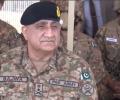
The chief of the army staff said that with one-third of the world in the Gulf region and elsewhere involved in some sort of conflict and war, "it is important that we keep the flames of fire away from our region."

'It is because of the bravery of Colonel Santosh Babu and his men that we have not seen a violent escalation anywhere else along the LAC.'

Xi commended the battalion members for their remarkable efforts in guarding China's border region, noting that they have dedicated their youth to securing the country's territorial integrity and have accomplished their missions well, state-run Xinhua news agency reported.
